
Beyond the Zipper: Designing Faster Food Delivery Bags with Magnetic Lids and Separate Drink Compartments
In last-mile food delivery, insulation is only one part of performance. Riders and restaurant staff also need fast access, stable packaging, easy cleaning and a layout that works for mixed orders.
A courier may open the same bag repeatedly during a shift—at pickup, during order checks and at every customer handover. If the opening system is slow or the interior is poorly organized, small delays and handling errors can accumulate across the route.
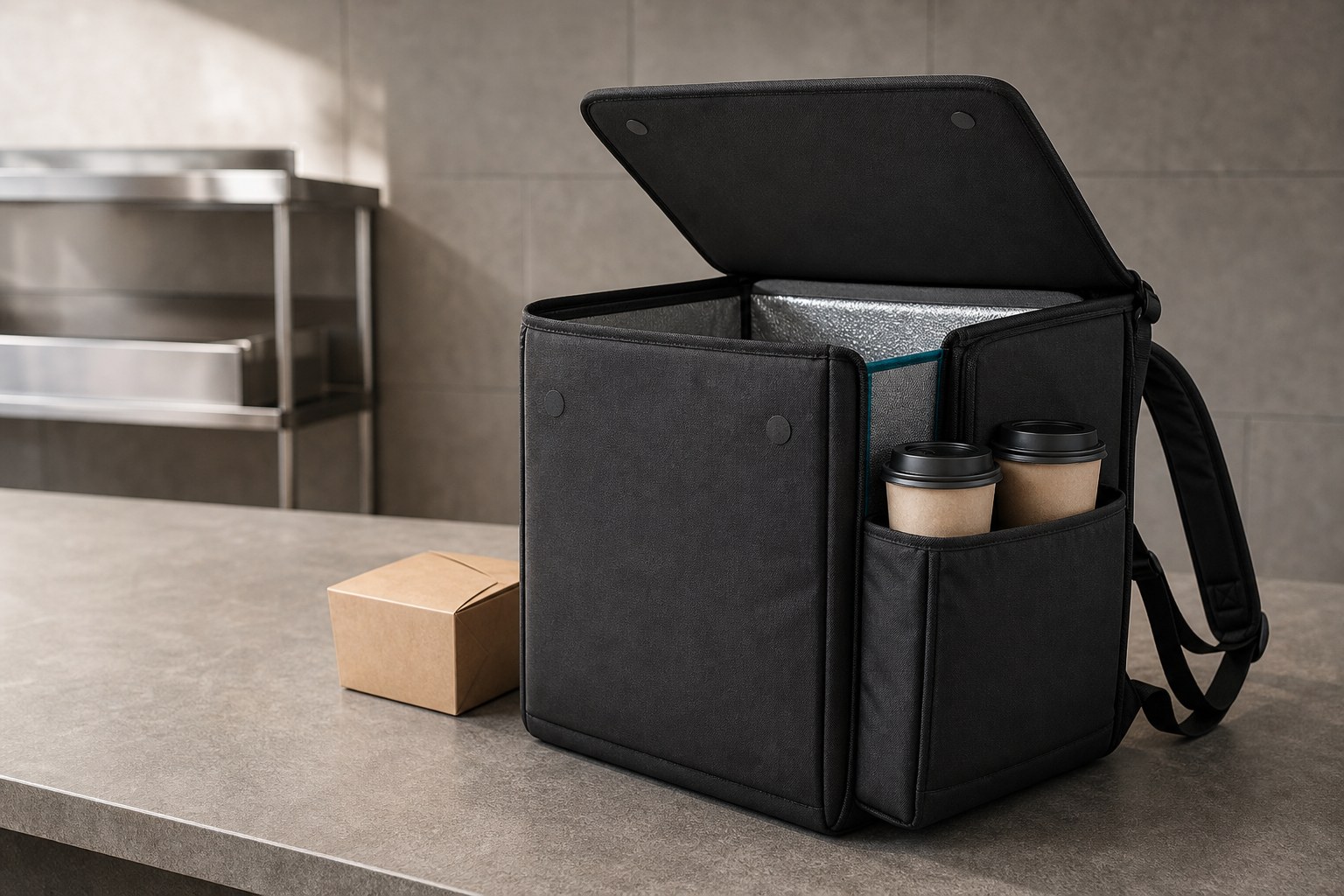
That is why some delivery operators are exploring a different configuration: a zipper-free insulated delivery bag with a magnetic lid and a separate drink compartment.
This design is not the right answer for every route. However, when engineered around the real order mix, it can reduce handling friction while keeping food and beverages better organized. For restaurants, cloud kitchens, grocery services and last-mile fleets, the value lies not in removing a zipper for its own sake, but in creating a more efficient loading and handover system.
Why Fast Access Matters More on High-Frequency Routes
A conventional zipper offers positive mechanical closure, but it also requires the user to locate the puller and guide it around the opening. That may be acceptable for long-distance transport or routes where the bag remains closed for extended periods. On high-frequency urban routes, however, staff may prioritize rapid one-handed access.
A well-designed magnetic lid can help the top panel return to its intended position without requiring a full zipper cycle. A wide top opening can also make it easier to load large takeaway boxes without tilting or compressing the packaging.
Potential operational benefits include:
• faster loading at restaurant counters;
• easier one-handed opening and closing;
• fewer exposed closure components around the top edge;
• a cleaner exterior for custom branding;
• simpler wipe-down around the opening area.
The important point is that a magnetic closure must be designed as part of the complete bag structure. Magnet strength, placement, lid stiffness and panel alignment all influence whether the closure works consistently after repeated use.
Magnetic Closure Is a System, Not a Shortcut
Removing the main zipper does not automatically make a bag faster or better. If the lid is too soft, the magnetic points may not align. If the magnets are too weak, corners may lift during movement. If they are too strong, staff may need unnecessary force to open the bag.
A practical zipper-free design should therefore consider:
1. Lid overlap: The top panel should extend beyond the opening to help direct normal rain and splashes away from the interior.
2. Panel support: Foam, corrugated plastic board or another reinforcement can help the lid retain its shape.
3. Magnet positioning: Closure points should align naturally when the bag is empty, partially loaded and full.
4. Opening direction: The lid should not interfere with loading, rider movement or vehicle mounting.
5. Weather expectations: A magnetic lid can support water-resistant construction, but it should not be marketed as fully waterproof without appropriate testing.
For prolonged heavy rain or high-speed exposed transport, a zippered or secondary secured closure may still be more suitable. The right closure depends on the route, vehicle, climate and frequency of access.
Why Drinks Need Their Own Compartment
Meals and beverages behave differently during transport. Food boxes are generally designed to remain horizontal. Cups and bottles need to stay upright, and their height, diameter and center of gravity vary widely.
When both are placed in one open chamber, braking, turning and walking can cause cups to lean against meal packaging. A leaking cold drink can then affect both order presentation and temperature control.
A food delivery bag with a separate drink compartment addresses this problem by treating beverages as a distinct load category. Depending on the order profile, the compartment can be designed with removable dividers, fixed partitions, cup holders or adjustable retention points.
A dedicated drink area can help:
• keep cups and bottles more stable;
• prevent drink containers from pressing against meal boxes;
• reduce direct contact between cold beverages and hot meals;
• speed up order checks at pickup and handover;
• contain minor leaks in a smaller, easier-to-clean area.
The compartment should be based on real packaging data rather than a generic assumption. Buyers should provide common cup diameters, bottle heights, drink counts and carrier dimensions during development. A section sized for two narrow bottles may not safely hold four large takeaway cups.
Designing for Uber Eats, DoorDash, Wolt, Glovo and Other Delivery Workflows
Restaurants and fleet operators working in delivery ecosystems associated with Uber Eats, DoorDash, Wolt, Glovo, Deliveroo, Just Eat, Lalamove and other last-mile services may handle very different order types. A pizza-focused restaurant has different bag requirements from a grocery operator, a coffee chain or a multi-restaurant courier fleet.
Instead of copying a single platform-style bag, buyers should define the operating conditions behind the order:
• typical number of stops per route;
• maximum meal-box dimensions;
• percentage of orders containing drinks;
• motorcycle, bicycle, scooter or car use;
• expected rain and temperature conditions;
• cleaning frequency;
• need for a foldable or rigid structure;
• logo visibility and reflective safety details.
Platform names can help describe the intended market, but the product specification should come from the actual delivery workflow. A bag used by an independent restaurant supporting DoorDash orders may need a compact hand-carry format, while a Wolt or Glovo fleet contractor may prioritize backpack stability, visibility and repeated daily access.
Trademark note: Third-party platform names are referenced only to describe common delivery-market use cases. This does not imply sponsorship, endorsement or an official partnership.
Material Options Should Match the Route
Herisen’s delivery-bag development experience covers multiple material systems rather than one universal construction. Available configurations in our product and project records include tarpaulin, 1680D polyester, 600D Cordura-type fabric, 300D Oxford fabric, PE foam insulation, aluminum-foil lining and corrugated plastic reinforcement.
Each material contributes something different:
• Tarpaulin: durable, easy to wipe and suitable for water-resistant exterior construction;
• 1680D or 600D polyester: abrasion resistance with a textile appearance;
• PE foam: thermal insulation and structural cushioning;
• Aluminum-foil or PEVA lining: a smooth interior that supports cleaning and thermal performance;
• Corrugated plastic board: shape support for walls, lids or bases;
• Removable dividers: flexible organization for meals, drinks or multiple orders.
Material thickness should be selected according to route duration and load, not simply increased without limit. More foam can improve thermal resistance, but it also reduces internal capacity, increases folded volume and may raise freight costs.
A foldable structure can be particularly valuable for distributors, restaurant groups and delivery fleets storing large quantities of bags. It can reduce warehouse and shipping volume while still providing working structure when reinforced correctly.
What Buyers Should Test on the First Prototype
A prototype should be evaluated as operational equipment, not only as a visual sample. Before approving bulk production, buyers should load it with the actual meal boxes, drink cups and bottles used in daily service.
Recommended tests include:
1. Repeated opening test
Open and close the magnetic lid repeatedly with one hand. Confirm that the magnetic points align when the bag is empty, partly loaded and full.
2. Movement and braking test
Carry or mount the loaded bag under realistic turning, stopping and walking conditions. Check whether the lid remains seated and whether cups stay upright.
3. Rain-resistance test
Test the lid overlap and exterior under the expected operating conditions. Water-resistant construction should be verified separately from any claim of full waterproofing.
4. Thermal test
Record starting and finishing temperatures using the intended route duration, meal packaging and ambient conditions. Hot meals and cold drinks should be assessed separately.
5. Cleaning test
Introduce a controlled amount of water or a representative beverage spill, then inspect seams, divider edges and the base after cleaning.
6. Fold-and-recover test
If the bag is foldable, collapse and reopen it repeatedly. The panels should recover sufficiently for the magnetic closure to realign.
7. Branding durability test
Check logo size, contrast and print adhesion after bending, cleaning and normal abrasion. Herisen supports options such as silk-screen, heat-transfer and digital printing, subject to the selected material and artwork.
From Prototype to Repeatable Production
Xiamen Herisen Commercial Co., Ltd. was founded in 2017, while its manufacturing base has worked in the bag industry since 2005. Herisen provides OEM and ODM support across food delivery bags, logistics bags, cooler bags and outdoor bags.
Our manufacturing and quality framework includes BSCI and ISO 9001 credentials, while available product programs can be developed to relevant requirements such as GRS, CPSIA, EN 71 and REACH, depending on the project and material selection.
For food delivery bags, Herisen’s documented production capability reaches approximately 50,000 pieces per month. Product records also show sample development in as little as five days for suitable projects, typical bulk lead times of approximately 45–55 days after sample approval, and an average warranty period of 180 days. Exact timing and terms depend on the design, material availability, printing process and order quantity.
For a magnetic-lid delivery bag, the development process can begin with the buyer’s packaging dimensions, route conditions, drink mix, closure preference, target quantity and brand artwork. The first sample can then be used to refine magnet strength, compartment dimensions, insulation, panel support and carrying configuration before production.
A Better Delivery Bag Starts with the Order Mix
The best delivery bag is not necessarily the one with the most hardware or the thickest insulation. It is the one that fits the operator’s route, packaging and handling rhythm.
For high-frequency restaurant delivery, a zipper-free magnetic lid can reduce unnecessary opening steps. A separate drink compartment can improve load organization and help protect both beverages and meals. Foldable construction can reduce storage and freight volume. Carefully selected exterior, insulation and lining materials can balance durability, cleaning and thermal performance.
The goal is not simply to remove the zipper. It is to redesign the handover process around the way riders and restaurant staff actually work.
If your team is developing a custom food delivery bag for restaurant orders, grocery routes or courier operations, Herisen can evaluate the structure through an OEM/ODM prototype before bulk production.
FAQ
Is a magnetic-lid food delivery bag completely waterproof?
Not automatically. A water-resistant exterior and overlapping lid can help protect against normal rain and splashes, but full waterproof performance requires appropriate materials, seam construction, closure design and testing.
Is a zipper-free delivery bag suitable for motorcycle couriers?
It can be, depending on speed, weather exposure, mounting method and closure security. Buyers should test the loaded prototype on the intended vehicle and route. A secondary restraint may be recommended for more demanding conditions.
Can the drink compartment be customized for different cup sizes?
Yes. The compartment can be developed around the buyer’s typical cup diameters, bottle heights, drink count and carrier format. Removable or adjustable dividers can support multiple order types.
Can the bag be customized for restaurants or delivery fleets?
Herisen supports OEM/ODM development, including dimensions, materials, insulation, dividers, carrying systems, colors and logo application. Final specifications should be confirmed through sampling.
Can the bag use recycled materials?
GRS-related material options can be evaluated according to the project. Availability, construction suitability and certification scope should be confirmed before quotation and production.
