From Farmer Market to Fashion Aisle: How the Polyester Shopping Bag Lost the "Cheap" Label and Became a Designer Staple
Introduction
Let’s be honest. For years, the polyester shopping bag had an image problem.
It was the freebie you got at a conference. The crumpled thing stuffed under your car seat. The bag your grandmother used to carry vegetables — functional, yes, but far from fashionable.
Fast-forward to 2026. That same material is now showing up in lookbooks, boutique checkouts, and even runway adjacent collections. What changed?
Not the material. The approach.
Today’s polyester shopping bag has been re-engineered, re-printed, and re-imagined. And for mid-to-high-end brands, it is quietly becoming one of the smartest accessories they can offer.
The Old Reputation: Why Polyester Felt “Cheap”
Old Problem | Why It Hurt |
Flimsy, soft structure | Bag collapsed, looked messy |
Thin webbing straps | Cut into shoulders, frayed quickly |
Basic solid colors | No visual interest |
Poor print durability | Logo faded after 2–3 uses |
In short: it was a commodity, not a product anyone wanted to be seen carrying.
The Transformation: 4 Upgrades That Changed Everything
1. Structured Bottom — The Game Changer
The single biggest improvement is a reinforced, hard bottom (often made of PE board, EVA, or multi layer interlining).
Before: A limp sack that tipped over in the car.
After: A bag that stands on its own, holds shape, and looks deliberate.
For boutique brands, this one feature alone justifies a higher price point. It says “designed,” not “thrown together.”
2. High-Impact Printing — From Blah to Bold
Basic heat transfer is out. High-resolution digital printing, sublimation printing and spot screen printing are in.
What changed?
✔Full-bleed, edge-to-edge patterns
✔Photorealistic images
✔Designer-style geometric or floral repeats
A printed polyester bag no longer looks like a banner ad — it looks like an intentional textile accessory.
3. Nylon Webbing Straps (Not Standard Polyester)
Standard polyester straps are functional but plain. Nylon webbing changes the hand feel and visual weight.
Nylon advantages:
● Smoother, silkier texture
● Higher tensile strength (holds more weight)
● Takes dye and printing better
● Looks and feels premium
Some luxury-leaning bags now use contrast nylon straps (black bag + cream straps) or edge-stitched nylon for an extra tailoring detail.
4. Hardware & Finishing Details
The devil is in the details. Premium polyester shopping bags now include:
Detail | Effect |
Metal zippers instead of plastic | Tactile, durable, “expensive” sound |
Leather look logo patch | Visual anchor |
Magnetic snap closure | Clean top line |
Internal bottle dividers | Functional surprise |
Key clip / small pocket | Adds utility without bulk |
None of these are expensive in bulk. But together, they change the emotional perception of the bag.
Case Study: What a “Designer Polyester Bag” Actually Looks Like
Imagine this spec sheet — all achievable at factory pricing:
● Material: 210D recycled polyester (RPET) or 300D high density polyester
● Structure: PE board bottom + side gussets for 3D shape
● Straps: 2.5cm nylon webbing, cross-stitched at attachment points
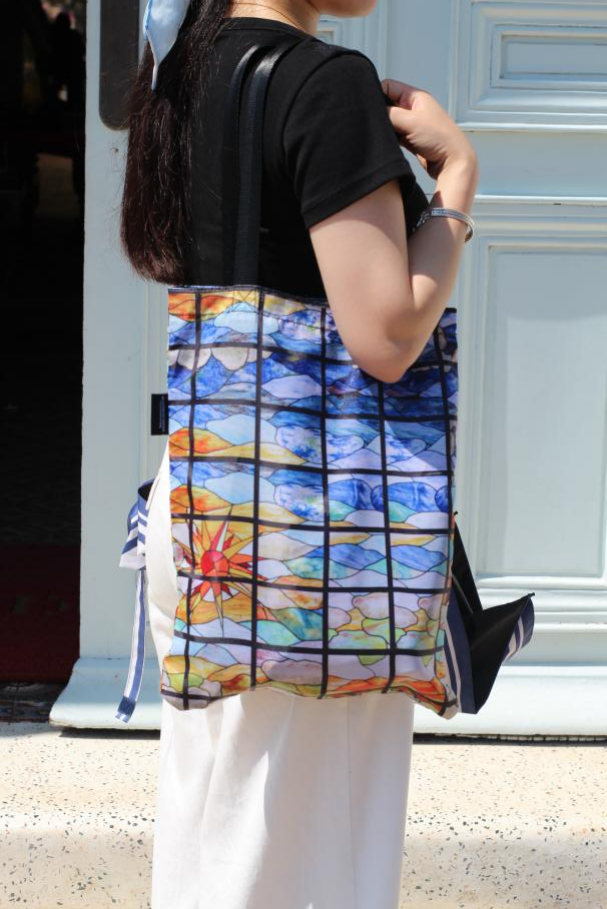
● Print: Full-wrap sublimation — custom floral or abstract pattern
● Closure: Magnetic snap + internal key hook
● Size: Folds flat into 15×15cm built-in pouch
This bag would retail for $25–40 in a boutique. It costs a fraction of that to manufacture. And it looks nothing like the old farmer‘s market bag.
Who Is Buying These Upgraded Bags?
We’re seeing three types of brands adopting the new polyester shopping bag:
1. Mid-tier fashion labels — as a “gateway” accessory (under $50 retail)
2. Lifestyle / home goods stores — as a branded checkout bag customers actually keep
3. Museum & gallery gift shops — as a functional art piece with famous artwork prints
What to Ask Your Factory When Going “Premium”
If you are a brand ready to upgrade your polyester shopping bag, here is your factory checklist:
✔ Bottom reinforcement: PE board, EVA, or double-layer interlining?
✔ Strap material: Nylon, cotton-webbed, or standard polyester?
✔ Strap attachment: Box-stitch + cross-stitch (not just single line)
✔ Print type: Sublimation (full color) vs. screen print (spot color)
✔ Internal finish: Bound seams or raw? Bound = premium.
✔ Foldability: Does it still fold into its own pocket with the stiff bottom? (Yes — design is possible.)
Conclusion: It’s Not the Material. It’s the Thinking.
Polyester was never the enemy. Undesigned polyester was.
Today, the same fabric that carried potatoes can carry a brand’s identity. A structured bottom turns floppy into confident. A vivid print turns invisible into memorable. Nylon straps turn cheap into tactile.
For brands that want an affordable, sustainable-friendly (RPET available), and genuinely desirable bag — the upgraded polyester shopping bag is ready. And unlike leather or heavy canvas, it still folds into a pocket when you don’t need it.
The farmer’s market is proud. The boutique is interested. And the customer? They might just keep this one.